The skills school never teaches — for every Chinese student, not just the lucky few.
Tact AI for Education is an AI-powered soft-skills platform that gives Chinese students affordable, daily practice in the conversations, confidence, and cross-cultural fluency that grades alone never measure — from elite international-school students to "left-behind" children in rural villages.
Our walk-through of a live Tact AI session — including the Cambridge tutorial-style scenario and a real-time soft-skills scoring report — is available to schools, educators, journalists, investors, and partners on individual request.
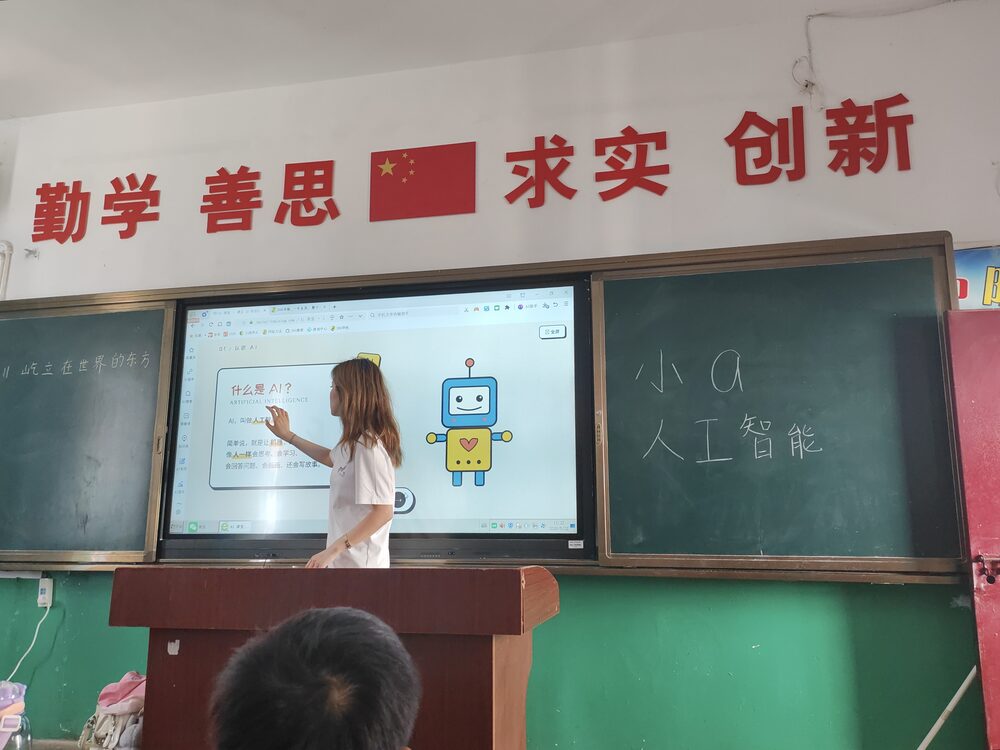
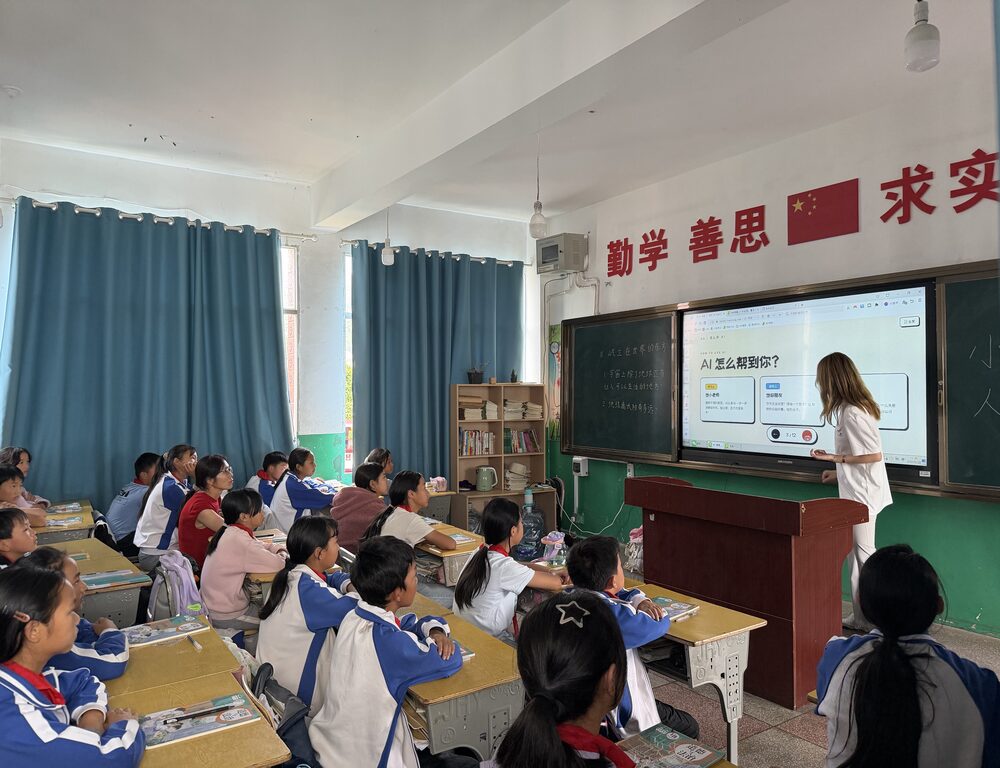
May 2026 — we brought a 45-minute AI-literacy class to Grade 5–6 students in a rural Yunnan school. Open the interactive material we designed and delivered for the day.
Introducing "What is AI?" to Grade 5–6 studentsA full classroom in rural Yunnan, May 2026
China's brightest students arrive abroad with the grades — and almost none of the skills.
应试教育 — China's exam-driven system — is brilliant at producing high test scores and almost silent on producing well-rounded young people. Confidence, empathy, conflict resolution, cultural fluency: the very skills that determine whether a teenager thrives in a tutorial at Cambridge, a hallway in Boston, or a city far from home, are the ones our schools have no time to teach.
The cost is no longer abstract. Mental-health crises, social isolation, and medical sabbaticals among Chinese students at top global universities have become a quiet epidemic. Today, the response is reactive — therapy, counselling, often only for families who can afford it. We want to flip that to a preventive model: integrate soft-skills development into a young person's daily learning routine, before the gap becomes a crisis.
"In the age of AI, the most competitive young people aren't those with the highest scores — they're those with a global mindset and the confidence to speak."
— The thesis behind Tact AI for Education
What we train
Nine soft-skill dimensions. One holistic profile.
Every Tact AI session is mapped against the nine competencies that universities, employers, and life itself actually reward. Each student's progress is benchmarked against the average profile of 200 Oxbridge-admitted students across 300+ behavioural data points.
How it works
Assess. Practise with AI. Validate with a real mentor.
15 minutes a day. A lifelike digital tutor on one end. A human expert on the other. The lowest-cost, highest-fidelity soft-skills training a Chinese student has ever had access to.
STEP 01 · Assess
Soft-skills portrait
Students take an initial assessment and receive a personalised radar profile across nine dimensions, benchmarked against 200 Oxbridge-admitted students.
STEP 02 · Practise
AI digital-human training
Lifelike avatar tutors with native English accents run 15-minute scenario sessions tied to the student's weakest dimensions — Oxbridge interview, MUN, scholarship essay, debate.
STEP 03 · Validate
Real-mentor consolidation
Senior practitioners — UK politicians, Oxford academics, OECD advisors — meet with each student to stress-test what they have learned and lock it in for the long term.
Real situations, not abstract drills
85+ scenarios. Mapped to nine soft skills. Tied to real student life.
From the Oxbridge interview room to the school dormitory at 11pm — every scenario in our library is a real, recurring moment in a Chinese student's life. Click a category to filter.
Where it matters most
The "left-behind" children no one is training.
An estimated 60+ million children in rural China — roughly one in four — are growing up while their parents work in distant cities. Their English teachers are often volunteers covering five subjects at once. Native-accent oral coaching, university interview prep, scholarship support: they are simply not on the menu.
A digital tutor changes the maths. The same lifelike avatar that coaches a Beijing student through a Cambridge interview can coach a child in Yunnan through GCSE-level oral English — over the rural broadband that now reaches almost every county. Same technology. Same accent. Same patience. No travel, no tuition fees, no compromise.
"Left-behind" children (留守儿童) is the standard term for the millions of rural Chinese children whose parents have migrated to cities for work, leaving them in the care of grandparents or boarding schools. They face the deepest educational-access gap in modern China.